Neurological synesthesia
Additional individual experiences, without assuming that mappings are bidirectional.
Investigating correspondences, interactions and transformations between sound, colour, spatiality, light, material, movement, gesture and temporality.
A research framework connecting perception, lived space, architecture, design, scenography, visual arts and sound arts.
This enquiry distinguishes four phenomena. Neurological synesthesia involves additional experiences that, for some individuals, can occur automatically and remain relatively stable. Crossmodal correspondences are recurrent or statistically shared associations between features across modalities. Multisensory integration combines sensory cues to interpret an event. Artistic transduction deliberately establishes mappings between properties through creative or experimental rules.
Additional individual experiences, without assuming that mappings are bidirectional.
Associations across pitch, brightness, size, position, texture or movement.
Combining temporal, spatial and sensory information when perceiving a situation.
Mappings defined, varied and tested through gesture, images, space and sound.
“Polymodal perceptual transversalities” is used here as a NEXAPSIS conceptual research framework, not as an established clinical category or evidence of neurological synesthesia.
Each dimension may be a source, context or outcome of an experience. These eight analytical domains should not be mistaken for eight independent biological senses.
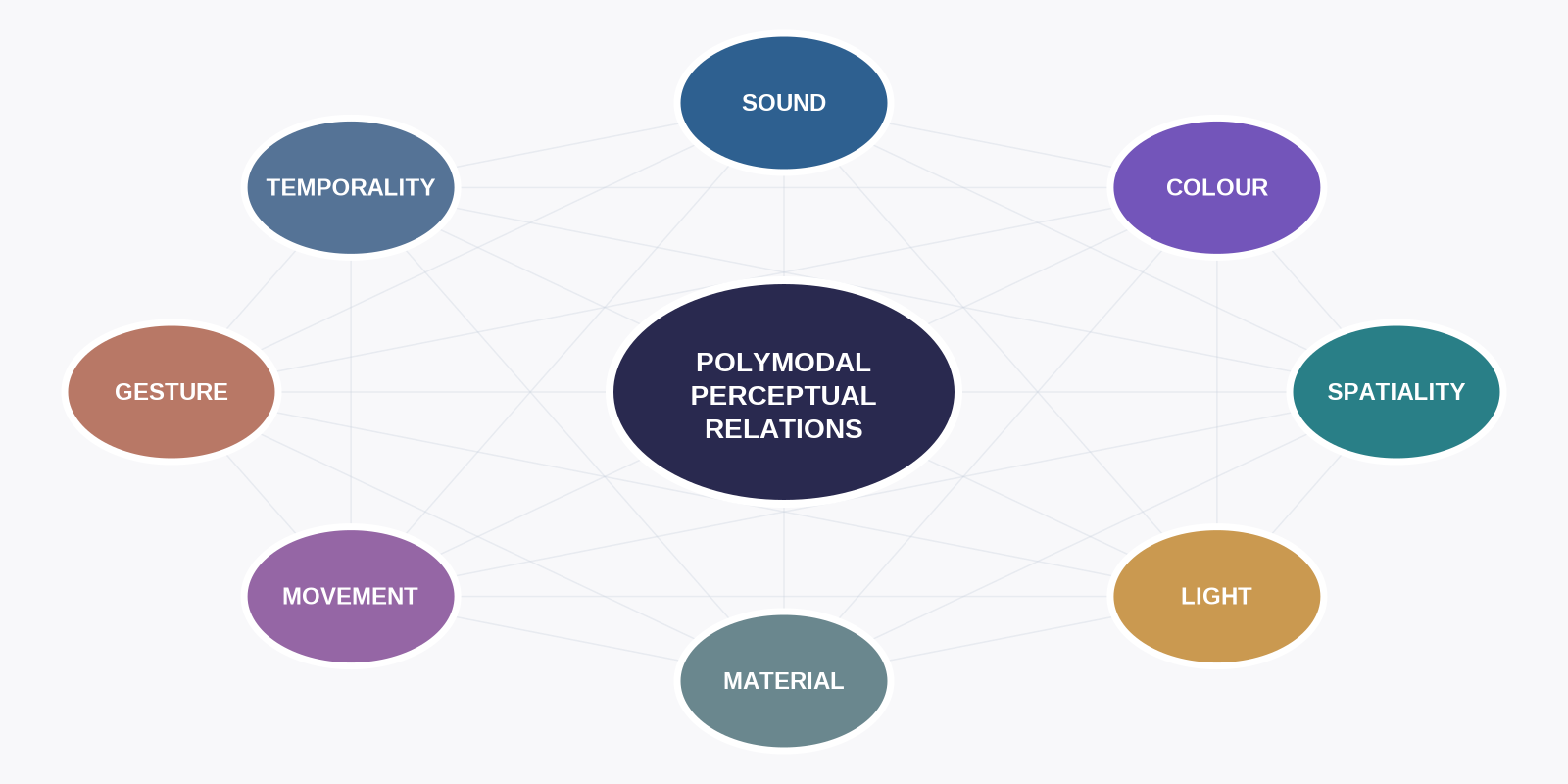
Pitch, timbre, rhythm, intensity, envelope.
Hue, saturation, lightness, contrast.
Distance, orientation, depth, envelopment.
Luminance, diffusion, direction, variation.
Texture, density, roughness, resonance.
Trajectory, speed, acceleration, repetition.
Intention, pressure, orientation, amplitude.
Duration, phase, anticipation, memory, persistence.
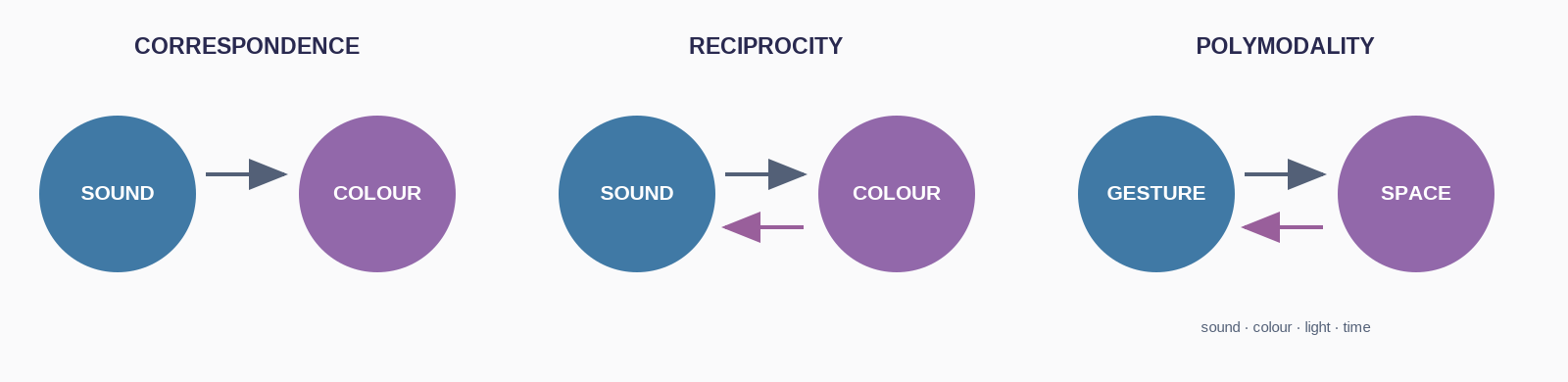
Sound → colour; light → space; material → sound. A mapping does not establish its reverse.
Sound ↔ colour, gesture ↔ spatiality: each direction may follow a different rule.
Sound, light, movement and geometry may contribute to a shared perceptual atmosphere.
A visual response modifies subsequent sound generation, subject to delay, gain and stability constraints.
With eight domains, 8 × 7 = 56 mathematically possible directed relationships can be counted between distinct domains. This is a combinatorial number, not a claim that 56 perceptual correspondences have been scientifically established.
Polymodal research cuts across the five NEXAPSIS fields without becoming a sixth field. It offers a shared hypothesis for design, observation and artistic practice.
Investigate geometry, perceived depth, bodily orientation, illumination and acoustic envelopment. Design experiential spaces rather than straightforward formal translations.
Experimental architecture ↗Examine how grain, texture, density and roughness may relate to sonic spectra, colour and movement, distinguishing physical effects from preferences and expressive conventions.
Visual and sound arts ↗Connect movement, lighting, built elements, projection and spatialised sound to create situated, evolving and potentially reversible experiences.
Hybrid installations ↗Consider gesture as an articulation of intention, movement and perception: drawing, action, instrumentation and spatial interaction all become creative interfaces.
Gesture, arts and interactions ↗Associated phenomena may coincide, follow each other or persist after an event. Synchrony, latency, memory, anticipation, periodicity and feedback all shape experience. Temporality is not reducible to musical tempo or graphic animation.
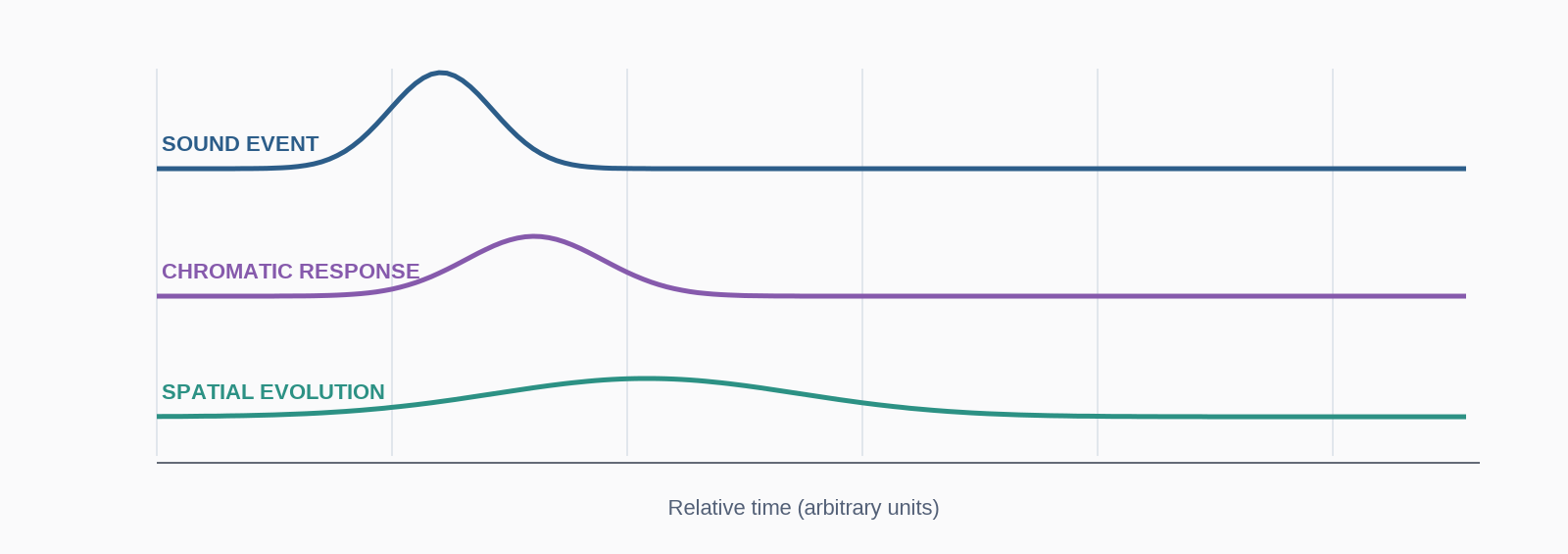
In an installation, a sonic impulse might trigger a delayed colour transition followed by a change in perceived space. Such systems can test order, persistence and reciprocal effects without purporting to demonstrate spontaneous neurological synesthesia.
Test the stability of selected correspondences and the extent of individual variation.
Compare two-domain relations with configurations involving three or more domains.
Explore whether temporal and spatial coherence affects perceived unity.
Study learning-dependent changes without equating them with developmental synesthesia.
Define measurable stimulus properties; compare unimodal, bimodal and polymodal conditions; counterbalance presentation order; collect matching judgments, response time, confidence, sensory comfort and subjective descriptions; repeat sessions to evaluate stability.
No universal sound-frequency-to-colour equivalence is assumed. Mappings remain explicit, contextual and revisable. Control sound intensity and problematic flicker, allow participants to stop, and document overload or discomfort.
This direction links psychophysics, phenomenology, perceptual science and practice-based research in architecture and the arts. The eight-domain model is a conceptual proposal to be tested, critiqued and refined with disciplinary partners.
J. Ward (2013), Synesthesia, Annual Review of Psychology — DOI 10.1146/annurev-psych-113011-143840.
C. Spence (2011), Crossmodal correspondences: a tutorial review, Attention, Perception, & Psychophysics — DOI 10.3758/s13414-010-0073-7.
B. E. Stein & T. R. Stanford (2008), Multisensory integration: current issues from the perspective of the single neuron, Nature Reviews Neuroscience — DOI 10.1038/nrn2331.
Adapted from the NEXAPSIS conceptual study “Synesthesia and polymodal perceptual transversalities”, 11 November 2026. Figures express conceptual models and are not clinical findings.